How to Choose a Software Development Company
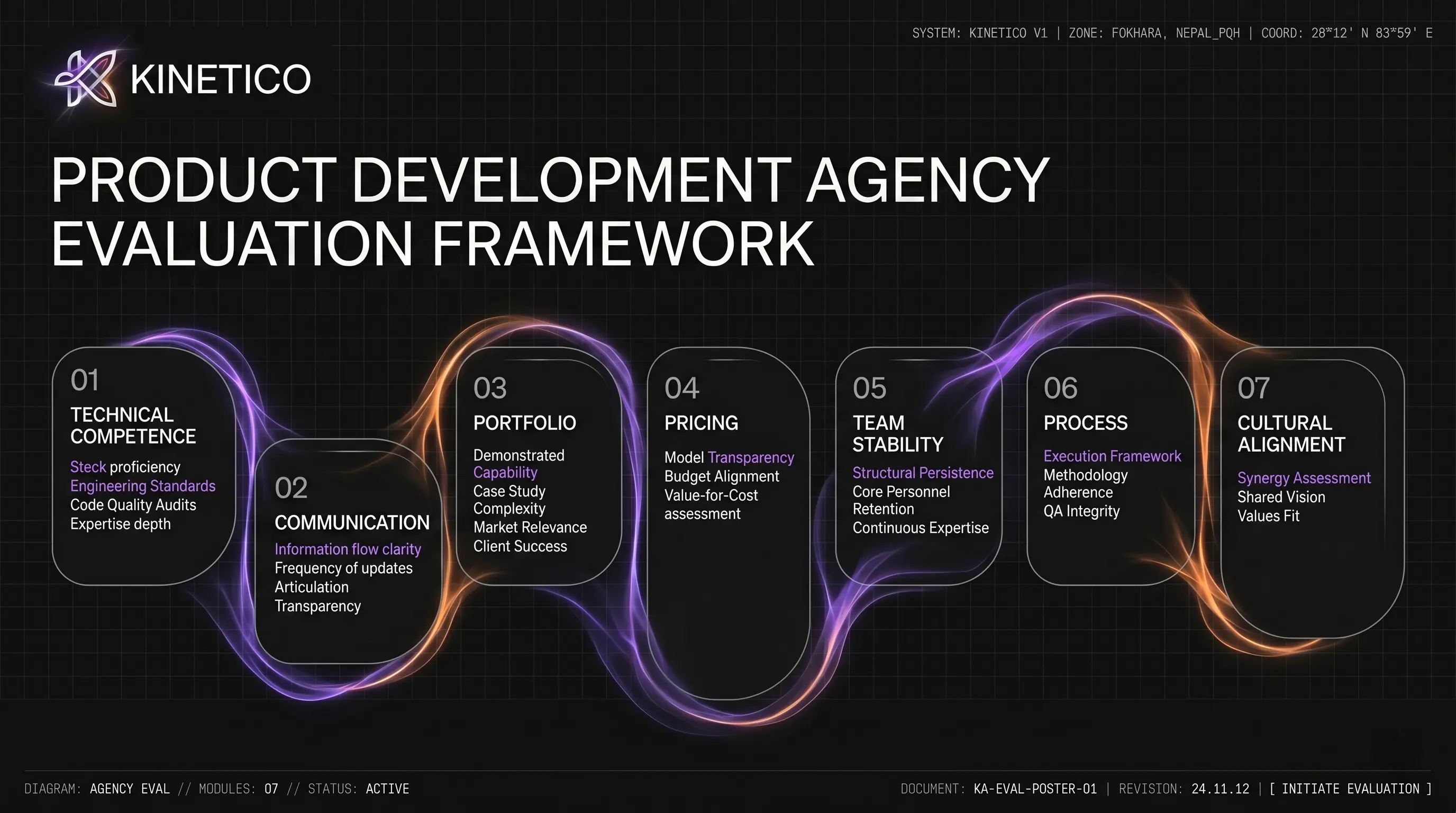
Choosing a product development agency requires evaluating seven criteria: technical competence, communication transparency, portfolio relevance, pricing structure, team stability, process methodology, and cultural alignment. The agency you select will shape your product for years—these criteria separate partners who deliver from those who delay. Kinetico, a Pokhara product design and engineering studio, publishes this framework based on 3 years of shipped product work.
What Makes an Agency Worth Hiring?
Most founders approach agency selection like hiring a freelancer—looking for the cheapest option that can "do the job." This is the wrong frame. An agency becomes an extension of your team. They make architectural decisions that outlive your current feature set, write code your future engineers will maintain, and ship (or fail to ship) the product that determines your market position. What we do under that frame is on our services page, and Top 10 MVP development companies applies these seven criteria to named vendors, including us.
The agencies that consistently deliver share a common trait: they treat your product as if it were their own. Not metaphorically—literally. The best agencies have skin in the game. They say no to features that will hurt user experience, push back on unrealistic timelines, and communicate problems before they become crises. This is what you are actually hiring for: judgment, not just execution.
How Do You Assess Technical Competence?
Technical competence is the minimum bar, not the differentiating factor. Every agency will claim expertise. Few can demonstrate it. Here is how to separate signal from noise:
Request Architecture Samples
Ask potential agencies to share architecture documentation from past projects—not just screenshots of the final product. A fintech dashboard built by a competent team will have clear data flow diagrams, API contract definitions, and security boundary documentation. If they cannot produce this, the codebase is likely held together by context that lives only in one developer's head.
Conduct Technical Interviews
If an agency cannot answer basic questions about database normalization, API versioning strategy, or error handling philosophy, run. Not because you need them to have the exact same opinions as you, but because genuine technical confidence shows through. Engineers who know their craft can explain tradeoffs. Only junior developers claim certainty on complex decisions.
Check Public Code and Contributions
Ask for their GitHub or GitLab profile. Look beyond commit counts to commit quality: Are they writing meaningful commit messages? Do they review each other's code (check for PR discussion)? Do they contribute to open-source or publish technical content? The 1% of engineers who maintain public technical identities are the same 1% who care deeply about craft. These are the people you want building your product.
Why Communication Transparency Matters More Than Portfolio
A stunning portfolio is the minimum expectation, not a Differentiator. Every agency with 3+ years of work will have screenshots of impressive products. What separates agencies is what happens when things go wrong— because they always do. The question to ask is not "what did you build?" but "what broke, and how did you handle it?"
Red Flags in Communication
- Delayed responses: If they take more than 24 hours to respond during the sales process, they will take 72+ hours when you are blocked on a critical bug.
- Vague progress reports: "We are making good progress" is not a status update. Real updates include: what was completed, what is in progress, what is blocked, and what the next milestone is.
- Over-promising: Agencies that promise 6-week delivery for a 6-month project are either dishonest or inexperienced. Either way, you will pay for it later.
Evaluating Portfolio Relevance
Portfolio relevance matters more than portfolio volume. An agency that built 50 e-commerce sites will struggle with complex financial modeling. Look for: Have they shipped a product in your vertical? Have they handled scale similar to what you anticipate? Do their design patterns align with your product's intended experience? At Kinetico, we specialize in WebGL-driven interfaces and fintech dashboards—the domains where visual complexity meets data density.
Which Pricing Model Should You Choose?
Every agency has a preferred pricing model. The model they prefer often reveals their risk tolerance and project selection strategy. Below is a comparison of the four dominant models:
| Model | Best For | Typical Range |
|---|---|---|
| Fixed Price | Well-defined, stable scopes | $15k - $150k |
| Time & Materials | Evolving requirements, startups | $50-150/hour |
| Dedicated Team | Long-term product development | $8k - $30k/month |
| Hourly Retainer | Ongoing maintenance, iterations | $5k - $25k/month |
Ranges reflect Kinetico's 2026 market observations across Nepal-based and international agencies. Request current quotes for your specific scope.
For early-stage products with evolving requirements, we recommend time-and-materials with a capped monthly budget. This provides flexibility while maintaining predictability. For well-defined MVPs with stable scopes, fixed-price can work—but only if you have thoroughly documented requirements (and we mean thorough: every edge case, every state, every error message documented).
“The agencies worth hiring are the ones honest enough to scope down. If a partner promises everything you ask for without pushing back on a single requirement, they're selling comfort, not outcomes—and you'll pay for that in the second invoice.”
How Do You Ensure Team Stability?
The best agency in the world becomes the worst agency if your team rotates every 3 months. At Kinetico, we maintain stable team compositions as a core operating principle: each product has a dedicated lead who remains involved from discovery through launch and beyond. This is not altruism—it is how you build the deep context that produces exceptional code.
When evaluating agencies, ask explicitly: Who will work on my project? How long has the team worked together? What is your retention rate? What happens if a team member leaves mid-project? The answers reveal whether they have built systems for continuity or whether you are gambling on individual heroics.
What Development Methodology Should You Expect?
Agile has become a meaningless buzzword. Every agency claims to be Agile. What you actually want to know is: How do they handle planning? How do they manage scope changes mid-sprint? How do they balance speed against quality? Do they have documented processes or do they improvise project-to-project?
At Kinetico, we use a hybrid approach: two-week sprints with documented acceptance criteria, weekly demos with stakeholders, and a change management process that quantifies the impact of scope changes on timeline and budget. If an agency cannot explain their process in concrete terms, they probably do not have one.
Why Cultural Alignment Predicts Long-Term Success
Technical competence, pricing, and methodology are necessary but not sufficient. The agency you choose will be in your ear for 12-24 months. If the communication styles clash, if one team thinks in spreadsheets while the other thinks in prototypes, if speed means different things to each party—you will spend more energy managing the relationship than building the product.
Cultural alignment is not about personality compatibility (though that helps). It is about shared values: How do you handle ambiguity? When is it acceptable to cut features vs. extend timeline? What does "done" mean? How do you define quality? These questions reveal alignment more than any portfolio review or technical interview.
The Decision Framework in Summary
Choosing a product development agency is a multi-year commitment. The criteria above—technical competence, communication transparency, portfolio relevance, pricing structure, team stability, process methodology, and cultural alignment—give you a framework for systematic evaluation rather than gut-feeling selection.
The best agency for your product is not necessarily the most expensive or the most famous. It is the one whose strengths align with your requirements, whose communication style matches your working preferences, and whose team demonstrates genuine investment in your product's success. Before you approach any of them, write the brief — our guide to writing a software development RFP covers the ten things a vendor needs to give you a comparable, fixed price. If you are evaluating options and would like a transparent conversation about whether we are the right fit, reach out. We will tell you honestly either way.
Continue Your Research
How Emotional Design Improves Product Adoption →
Learn why interfaces that feel right outperform those that merely function.
Meet the TeamExplore Our Work and Process →
See our portfolio, read our technical blog, and understand our methodology.
Related ReadingThe MVP Development Process, Week by Week →
What a good partner's process actually looks like: five stages, weekly demos, no handoff.
Partner ProgramEarn 20% Commission Referring Clients →
If you know founders evaluating agencies, we offer industry-leading commissions.
Frequently Asked Questions
How much does a product development agency cost?
Agency costs vary by geography and model. South Asian agencies like Kinetico typically range from $30-80/hour, while US/EU agencies charge $150-300/hour. Fixed-price projects for MVPs typically start at $15,000 and scale with complexity. Full enterprise systems can reach $500,000+. Choose a model that matches your requirements volatility.
Should I hire a local or remote agency?
The decision depends on your priorities. Local agencies offer timezone overlap and in-person meetings but cost 3-5x more. Remote agencies in South Asia provide strong value with excellent English communication. The key is finding agencies with documented async communication processes—the timezone difference becomes an asset when they work while you sleep.
What questions should I ask before hiring an agency?
Ask: What is your development methodology? How do you handle scope changes? What is your communication cadence? Can I speak with past clients? Who will work on my project? What happens after launch? How do you handle debugging? Request code samples and conduct technical interviews with their senior team. Verify claims through reference checks with past clients about timeline adherence and code quality.
Ready to evaluate agencies systematically—or want us to be one of the options?
Related articles
Top 10 MVP Development Companies in 2026, Compared on What They Publish
Ten MVP development companies across three shapes, compared on the four things you can verify before a call: published timeline, published price, whether design and engineering come from one team, and whether they state you own the code — including where Kinetico fits and when not to pick us.
Outsourcing Software Development for Startups: Pros, Cons, and How to Do It Without the Horror Stories
Why the failure stories founders trade on Reddit keep happening — hourly incentives, no one reviewing the work, no written scope — and the contract terms that remove each one. Pros and cons with sourced numbers, which outsourcing model fits which startup, a 7-step how-to, cost by builder type, red flags, and when not to outsource.
How Much Does It Cost to Build an MVP in 2026? Real Numbers by Scope
MVP development cost in 2026: $15k–$50k over 6–12 weeks with a design-and-engineering studio — by scope tier, product type, phase and region, with a week-by-week timeline and the estimation model behind the numbers.
How to Write a Software Development RFP (and When a One-Page Brief Gets You a Better Price)
The ten sections a software development RFP needs and what each one does to the quote that comes back; how to describe scope in roles, screens and integrations so a vendor can price it; why to state the budget as a band; RFP vs RFI vs RFQ vs scope of work vs statement of work; a one-page brief template for builds under $50k; how many vendors to send it to; the red flags in the proposals.