How to Write a Software Development RFP (and When a One-Page Brief Gets You a Better Price)
The guides that rank for this question are written for procurement teams buying six-figure builds. This one is written by a studio that receives briefs, for founders buying a first version. What a vendor needs from you to name a fixed price, and what to do with the proposals that come back.
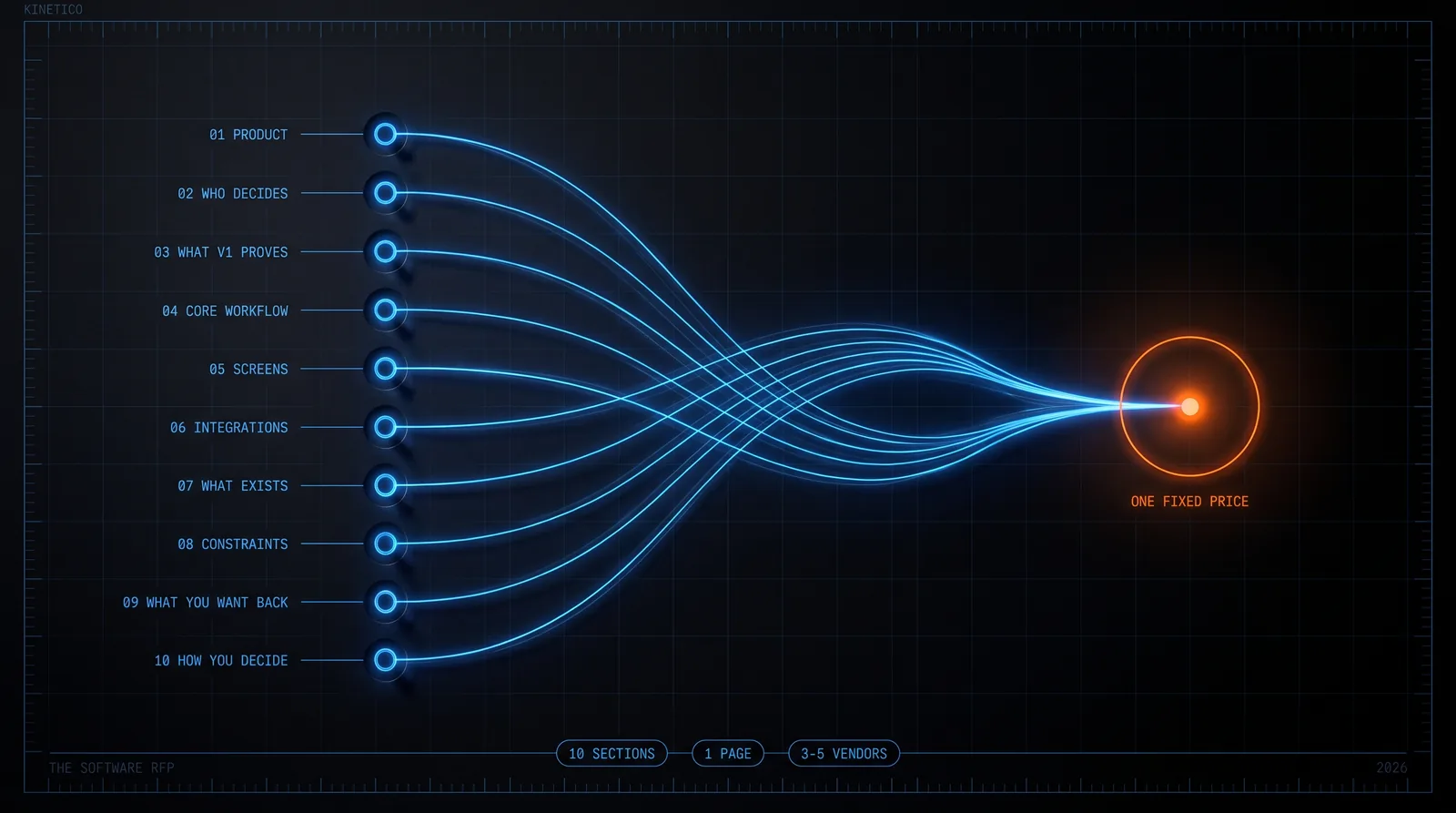
A software development RFP needs ten things: the product, who you are, what v1 must prove, scope in roles, screens and integrations, technical facts, a date, a budget band, what you need from vendors, how you will decide, and how to reply. Under $50k, put them on one page and send it to 3–5 vendors. Kinetico, a product design and engineering studio, turns that brief into a written scope and fixed price ($15k–$50k, 6–12 weeks) in 5 working days.
We sit on the receiving end of this document, so this guide is written from that side. The section list is the one the ranking guides agree on (ScienceSoft, TechMagic, JayDevs, Troy Web), each quoted and linked where it is used. What they do not tell you is what each section does to the number that comes back, or how a vendor turns three adjectives into a price. That is the part we can add. The guide sits in branch 2 of our library, before how to choose a product development agency, and next to what MVP development with Kinetico looks like once a brief arrives.
Key Takeaways
- •Three of the ten sections change your price: scope (roles, screens, integrations), budget (a band, and what it covers) and timeline (a date with its reason). The other seven decide who replies and whether you can compare them.
- •The same vague sentence prices as Lean at one vendor and Full at another, because each maps adjectives to its own tiers. Written in counts, it lands in one tier everywhere. 1 role, 6 to 10 screens, one workflow: 6 weeks. 3 roles, 20 to 30 screens, billing, 3+ integrations: 10 – 12 weeks.
- •State the budget as a band and say what it must cover. Troy Web makes this one of its four rules; the mechanism is that vendors size the scope to the band instead of to their own tiers, and the ones that cannot work inside it stop wasting your time.
- •An RFP gets proposals. A scope of work says what gets built. A statement of work is what you sign: the scope plus schedule, acceptance criteria, payment model, ownership and change handling. In a fixed-price engagement the written scope and the price are the SOW in all but name.
- •Send it to 3 to 5 vendors (ScienceSoft, JayDevs), not twenty. JayDevs puts a proper read of one proposal at about 120 minutes. The most informative line in any reply is the answer to “what would you cut to land in the band.”
What is a software development RFP, and do you need one?
A request for proposal is the document you send to a short list of vendors so their replies can be compared like for like. Same product, same constraints, same questions, answered by each. It is one of four instruments, and which one you need depends on how much you already know and how much you are spending.
| Instrument | Use it when | It asks for | What comes back |
|---|---|---|---|
| RFI, request for information | You have a problem, no scope yet, and want to know who is out there | Capabilities, case studies, team, rough ranges | Marketing decks. Good for a long list, useless for a price |
| RFP, request for proposal | You know what you want built and need proposals you can compare | Approach, team, timeline, price and terms, against your scope | 3 to 5 proposals you can lay side by side, if the scope was written in nouns |
| RFQ, request for quotation | The scope is fixed to the screen and only price varies | A number | Numbers, each assuming nothing in the scope will move |
| One-page brief | A first version inside $15k–$50k, from a studio that quotes from a scoping call | The same ten facts an RFP carries, on one page | A written scope and a fixed price in days, not weeks |
The first three rows are standard; ScienceSoft and JayDevs both open with a version of that table. The fourth row is ours, and it comes from watching what a formal RFP does to a small build. The format was designed for procurement: many stakeholders, a legal review, a vendor pool that has to be treated equally, a paper trail that survives an audit. A founder buying a $15k–$50k first version has none of those constraints. The twenty-page document takes weeks to write, the small studios that would do the work skim it, and the large agencies answer it with a template. The information inside it is still needed. The format is not.
What should a software development RFP include?
ScienceSoft lists ten sections. JayDevs compresses them to five. TechMagic spreads them over six steps. They are the same ten things under different headings. What none of the guides says is what each section does to the number that comes back, which is the only reason to write any of them.
| Section | What it is for | What happens to your quote without it |
|---|---|---|
| Project overview | One paragraph. What the product is, for whom, and what changes for them when it exists | The vendor guesses the product category and prices a different product |
| Company background | Stage, funding, who decides, who on your side is technical | A seed-stage founder gets quoted like an enterprise procurement, with the process overhead priced in |
| Goals and target users | The one thing v1 must prove, and the user roles who will use it | Scope grows to cover every user you might ever have |
| Scope of work | Roles, screens, the core workflow, integrations, admin. Countable nouns | The biggest source of incomparable proposals. Every vendor scopes their own product and prices that |
| Technical requirements | Existing stack, hosting, data location, compliance, and what already exists (design files, a data model, a prototype, code) | Quotes to rebuild things you already have. The wrong stack. Compliance work discovered in week six |
| Timeline | The date that matters and the reason for it | Padded schedules, or unrealistic ones nobody challenged because nobody knew why the date was there |
| Budget | A band, and what it must cover (design, QA, launch, or engineering only) | Proposals spread across an order of magnitude. The vendors you wanted do not reply |
| Vendor requirements | What you need to see. Published pricing, named case studies, whether the designers also write the code | Proposals written to the vendor's template rather than to you |
| Selection criteria | How you will decide, in what weight | Each proposal optimises for whatever that vendor thinks you care about |
| Submission instructions | Format, deadline, page limit, one contact | Twenty-page PDFs, sales calls you did not ask for, no deadline to hold anyone to |
Three rows move the price: scope, budget and timeline. The other seven decide who replies and whether you can compare the replies. The founder-written RFPs that reach us are usually the wrong way round. Long on the second group, with a company story, a vision and a selection process. Thin on the first, with a scope of three adjectives and a budget that is "to be discussed." The next two sections are about fixing that.
How do you describe scope so a vendor can price it?
In nouns a vendor can count. Here is what happens to a sentence we see in some form in most briefs: "a simple, modern booking platform for tour operators, with payments and notifications." Read charitably, that is one operator role, one booking workflow and a hosted checkout. Read the way a vendor pricing by the hour reads it, it is three roles (operator, guide, customer), a customer-facing site, an operator dashboard, an admin console, subscription billing, and email plus SMS notifications with their own settings screens. On our published tiers the first reading is Lean, $15k – $22k over 6 weeks. The second is Full, $35k – $50k over 10 – 12 weeks. Same sentence, a spread of more than two to one, and every vendor who replied was honest. The sentence was the problem.
Written in counts, the same product is "two roles, about fourteen screens, one book-and-pay workflow, Stripe and transactional email, a minimal admin." That lands in Standard at every vendor with published pricing, because scope sizing works the same way everywhere: roles multiply screens, screens multiply states, integrations multiply failure cases. Our tiers are one such vocabulary, identical to the pricing page:
| If your scope reads like | Tier | Weeks | Fixed price | It proves |
|---|---|---|---|---|
| 1 user role · 6–10 screens · auth + one core workflow · 0–1 integration | Lean | 6 | $15k – $22k | Will anyone use the core loop at all? |
| 2 roles · 12–20 screens · core workflow + admin · payments or 2 integrations | Standard | 8 | $22k – $35k | Will they pay, and can you operate it? |
| 3 roles · 20–30 screens · billing, notifications, reporting · 3+ integrations | Full | 10 – 12 | $35k – $50k | Can this run as a business, not a demo? |
Four things a vendor counts that founders usually leave out. Roles first, because every role brings its own screens, permissions and states, and the second role is the most expensive line in most briefs. Ask whether that role could read a shared view or a spreadsheet in v1. States second: every screen has an empty state, a loading state, an error state and at least one edge case, so fourteen screens is closer to fifty designed states, and a vendor who quotes "fourteen screens" without asking about states has not priced them. Integrations third, because each one is an auth flow, webhooks and a failure path, not a checkbox. And what already exists, because a half-finished codebase is the most expensive thing you can hand a vendor. If you have code, say whether you would accept a rebuild; a vendor who cannot audit it will quote one anyway.
For the features themselves, JayDevs offers a per-feature template worth borrowing whole. For each feature, write its feature, description, goal, user problem, value, assumptions and what is forbidden. The last field is the one that earns its place. "Guides must not be able to see customer payment details" is scope. It removes a screen, a permission and a class of bug from every proposal at once.
One caveat from the people who do the estimating. The top reply in an r/programming thread on scoping projects you have never done before (257 points, 92 comments) makes the point bluntly: the hard part is the information you do not have yet, and no template collects it. True, and it is why field 7 of the brief below asks what exists and why a scoping call beats a longer document. Write down what you know. Say plainly what you do not. A vendor can price an unknown that has been named; it cannot price one that has been hidden under an adjective.
Should you state your budget in a software development RFP?
Yes, as a band, and say what the band has to cover. Troy Web makes "be upfront about the budget" one of its four rules for an effective RFP. The reason is mechanical. Without a band, each vendor prices your scope against its own tiers, and the replies cannot be compared because they are for different amounts of product. With a band, vendors that cannot work inside it do not reply, and the ones that do tell you what fits and what they would move to a second version. That trade-off is the decision you needed help with in the first place.
The fear is that stating $30k means every proposal comes back at $30k. Some will. That is what the "what would you cut" line in the brief is for. A vendor that fits everything in at exactly your number has either a generous band or a scope thinned somewhere it did not mention, and the restated scope will show which. To pick a band, here is the 2026 market by who builds it, in rounded ranges:
| Who builds it | First version | Weeks | Note |
|---|---|---|---|
| Freelancer | $10k – $40k | 8 – 16 | One person, one skill set; design and QA usually thin |
| Design + engineering studio (Nepal / South Asia) | $15k – $50k, fixed | 6 – 12 | Kinetico's published tiers; one team, code in your repo, no retainer |
| Offshore dev shop (Eastern Europe / LATAM) | $30k – $80k | 8 – 14 | Design often subcontracted → handoff loss |
| US / Western European agency | $60k – $200k+ | 10 – 20 | Highest rate; often the same seniority you can hire elsewhere |
The rows are the same as on our software development cost breakdown. The Kinetico row is published pricing; the others are market bands. State the band that matches the kind of vendor you are writing to, and say whether it includes design, QA and launch. Most arguments that start "the quote was wrong" are arguments about which of those three the number was supposed to cover.
What is the difference between an RFP, a scope of work and a statement of work?
An RFP is what you send out. A scope of work is the part of it that says what will be built, and the part of the eventual contract that says the same thing. A statement of work (SOW) is the contract-grade document you sign with the vendor you chose: the scope, plus schedule, acceptance criteria, payment model, ownership and how changes are handled. Relevant Software describes the scope of work as a subset of the statement of work and lists ten SOW components, from introduction and purpose through deadlines, monitoring, acceptance criteria and contract mode. It also names three SOW types. Detail or design, level of effort, and performance-based, which map onto fixed price, hourly, and outcome-based engagements. Know which one you are signing, because a level-of-effort SOW attached to a fixed-scope brief is a contract that promises hours, not the product.
Byte Advisory puts it as seven things a software SOW must define before the first sprint:
- Define more than the feature name
- Agree on what “finished” means
- Identify what the client must provide
- Match the SOW to the delivery model
- Decide how changes will be handled
- Clarify ownership and handover
- Separate warranty, support and maintenance
Every one of those seven is a question you can ask in the RFP instead of discovering in the contract. That is the practical reason to send a good brief. The proposals that come back are drafts of the SOW, and the vendor that answers all seven unasked has signed contracts like this before. In a fixed-price engagement, ours included, the written scope and the price are the statement of work in all but name: modules, screens, states, integrations, weeks, one number, and the terms for changes and handover next to it.
What does a one-page software development brief look like?
This is our recommendation for anything inside the $15k–$50k band. It carries the same ten facts as the RFP section list, in the order a vendor reads them, and it fits on one page. The example column is a placeholder product, not a client, and shows the level of detail that gets a fixed price back.
| Field | Example (illustrative) |
|---|---|
| 1. The product in one sentence | A booking and payment web app for independent tour operators, replacing WhatsApp threads and a shared spreadsheet. |
| 2. Who you are, who decides, who is technical | Two founders, pre-seed, 40 operators on a waitlist. Priya decides and can join a 30-minute demo every week. Nobody on our side writes code; our advisor can review the repo. |
| 3. What v1 must prove, and for whom | Operators will move their bookings onto it and customers will pay online. Roles: operator (owner), guide (reads today's bookings), customer (books and pays). |
| 4. The core workflow, end to end | Customer picks a date and pays. Operator sees it. Guide is notified. Customer gets a confirmation. Everything not on that path is v2. |
| 5. Screens you can already name | Public listing, booking flow, operator dashboard, booking detail, settings, admin. We count about 14. Tell us if you count differently. |
| 6. Integrations | Stripe for payments. Transactional email (your pick). Google Calendar sync is v2. |
| 7. What already exists | A Figma prototype of 6 screens. A Google Sheet with 14 months of real bookings (attached, anonymised). A domain. No code. |
| 8. Constraints | Budget band $25k to $35k, covering design, build, QA and launch. Live before the season opens on 1 March, because operators set prices in February. Customer data in the EU. No native mobile app in v1. |
| 9. What you want back | The scope restated in your words (roles, screens, integrations, weeks). One fixed number. What you would cut to land in the band. Who designs and who codes. What we own at handover. |
| 10. How you will decide, and by when | Scope clarity 40%, price and terms 30%, evidence of similar builds 30%. Decision by the 15th. One contact. Replies under three pages. |
Field 2 is the one no RFP template asks for and every vendor wants. Who decides, whether they can make a weekly demo, and whether anyone on your side can read a pull request. It changes how a vendor writes the proposal, how it plans reviews, and whether it budgets for explaining technical trade-offs to a non-technical decision maker. Field 8 states the band, the date, and the reason for the date, and the reason matters more than the date. A vendor who knows operators set prices in February will propose a scope that ships in February, not a scope that is complete. Field 9 asks for the trade-off in advance, which is the most informative line you will read in any reply.
Attach whatever exists. The deck, the Figma file, the spreadsheet, the no-code prototype. A screenshot of the spreadsheet you are replacing is worth a page of prose about the problem, because the spreadsheet is the data model. Its columns are your fields, its tabs are your roles, and the cells people keep getting wrong are the validation rules.
How many vendors should you send it to, and how do you compare the proposals?
Three to five, after a short list. ScienceSoft recommends 3 to 5 companies rather than an open call. JayDevs says the same and puts a proper evaluation of one proposal at roughly 120 minutes, so twenty replies is a working week of reading. Shortlist on things a proposal cannot fake. Published pricing, named and linkable case studies, whether the designers also write the code. Our guide to choosing a product development agency covers the criteria, and if the build is an MVP the six questions in our comparison of MVP development companies are the ones to put to every finalist. Then lay the proposals side by side on eight columns:
| Column | What to look for |
|---|---|
| Scope restated | Did they write your scope back in their own words, with counts, or paste yours? A restatement with a question in it is the best sign you will get |
| Price shape | One fixed number against that scope, a band, or an hourly rate with an estimate. Fixed is comparable. Hourly is a forecast, and the incentive runs the wrong way |
| What they would cut | A vendor that names what to move to v2 has understood the band. One that fits everything in has either a generous band or a silently thinned scope |
| Who designs, who codes | Same people, a design partner, or a design phase handed to engineering. The handoff is where screens, states and edge cases go missing |
| First working demo | When you see a signed-in, deployed build. Week two, or at the end? |
| Ownership at handover | Repository in your GitHub organisation from the first commit? Design files, deployment accounts, documentation? |
| Change handling | When you change your mind: absorbed, written up with cost and weeks before work starts, or billed by the hour after the fact? |
| After launch | Retainer required, optional, or none. Warranty period. Support and maintenance priced separately or bundled |
The second and last columns do the most work, and both of them turn on the pricing model rather than on the number. A fixed quote and an hourly estimate are not comparable objects, and the change-handling answer is usually where the real difference between two similar proposals lives — both are worked through in software development pricing models.
Weight the columns the way your selection criteria said you would, then tell the vendors who lost why. It costs a paragraph, and it is how a short list becomes a bench you can go back to for the next version.
What are the red flags in the proposals that come back?
- An hourly rate with an estimate and no cap, for a scope you wrote in counts. That is a forecast, not a price.
- Your scope pasted back unchanged. A vendor who read it will restate it, question one part and suggest cutting another.
- Everything you asked for fits the band, with no trade-off named. Something has been thinned without telling you, and it is usually design QA, edge states or handover.
- Design by a separate team or partner. Ask who owns the gap when a screen the designer drew has a state the engineer did not build.
- The repository stays theirs until final payment, or the deployment accounts are in their name. Ask for your GitHub organisation from the first commit.
- No demo cadence. If the first working software you see is at the end, you have bought a reveal.
- A retainer folded into the price as a condition of launch, or support and maintenance bundled with no line between them.
- Superlatives where evidence should be. “Award-winning” and “world-class” with no named, linkable case study behind them.
None of these is disqualifying on its own. An hourly model is the right one for a team you direct, and a large agency may reasonably hold the repository until the contract is signed. They are flags because each one moves a risk from the vendor to you without saying so. Ask about it. The answer tells you more than the proposal did.
What happens after you send a brief to Kinetico?
One 30-minute scoping call produces a written scope and a fixed price; you decide from there. The call is 30 minutes. You bring the brief, the constraint and whatever exists. The written scope, meaning modules, screens, states, integrations, weeks and one number, arrives within 5 working days, and nothing starts until you have it. Tiers are Lean $15k – $22k / 6 weeks, Standard $22k – $35k / 8 weeks and Full $35k – $50k / 10 – 12 weeks. Changes that swap one thing for another of the same size are absorbed inside the fixed price. Changes that add scope are written up with their cost and weeks before any work starts, so the number only moves when you decide it should. You own the repository, deployment accounts, design files and documentation at handover, with no licence or lock-in. No retainer is required to keep the product running. Third-party services (payments, email, hosting, monitoring) are bought, not built, at v1; their fees are in your accounts and listed in the scope. We don't sell staff augmentation or engineers by the month. We don't take $250k enterprise programmes — that isn't what the studio is built for. The same senior people design the screens and write the code, in your GitHub organisation from the first commit, with a weekly demo of working software. Details on the MVP development page. If you would rather size the scope yourself first, the cost calculator asks the same six questions the scoping call does.
Frequently asked questions
What is an RFP for software development?
A request for proposal is a document a buyer sends to several software vendors describing the product they want built, the constraints (budget, dates, stack, compliance) and how proposals will be judged, so that the replies can be compared like for like. It sits between an RFI (a request for information, used to shortlist vendors before you have a scope) and an RFQ (a request for quotation, used when the scope is fixed and only price varies). For a first version under $50,000, a one-page brief carrying the same ten pieces of information does the same job with less overhead.
What should a software development RFP include?
The guides that rank for this question converge on ten sections: project overview, company background, goals and target users, scope of work, technical requirements, timeline, budget, vendor requirements, selection criteria and submission instructions. The three that change your price are scope (described as user roles, screens and integrations, not adjectives), budget (a band, so vendors size the scope to it instead of to their own tiers) and timeline (a date with a reason). The rest decide who replies and how easily you can compare them.
Should you state your budget in a software development RFP?
Yes, as a band. Without it, every vendor prices the scope to its own tiers, and you get proposals ranging across an order of magnitude that cannot be compared. With it, vendors that cannot work in the band do not reply, and the ones that do tell you what fits inside it and what they would move to a second version, which is the information you actually need. Troy Web Consulting makes being upfront about the budget one of its four rules for an effective RFP; our published tiers exist so that founders have a band to state.
What is the difference between an RFP, a scope of work and a statement of work?
An RFP is what you send out to get proposals; a scope of work is the part of it (and of the eventual contract) that says what will be built; a statement of work is the contract-grade document you sign with the vendor you chose, which contains the scope plus schedule, acceptance criteria, payment model, ownership and how changes are handled. Relevant Software describes the scope of work as a subset of the statement of work. In a fixed-price engagement the written scope and the price are the statement of work in all but name.
How many vendors should you send a software development RFP to?
Three to five, after a short list. ScienceSoft and JayDevs both recommend 3–5 recipients rather than an open call; JayDevs puts the cost of properly evaluating one proposal at roughly 120 minutes, so 20 replies is a working week of reading. Shortlist on the things a proposal cannot fake (published pricing, named case studies, whether the designers also write the code) and send the brief to the vendors that pass.
Do you need an RFP to get a fixed price for an MVP?
Not from a studio that quotes from a scoping call. At Kinetico the process is a 30-minute call where you bring the problem, the constraint and whatever exists (a deck, a Figma file, a spreadsheet, a no-code prototype), and the written scope (modules, screens, states, integrations, weeks) and a fixed price arrive within 5 working days. The published band is $15,000–$50,000 over 6–12 weeks. The one-page brief in this guide is the same ten pieces of information, written down in advance, so the call is spent on the scope rather than on the basics.
Who wrote this, and where the claims come from
Written by Pukar Khanal and the Kinetico team, a product design and engineering studio in Pokhara, Nepal, where the same senior people design the product and write the code that ships it. We are a vendor that receives briefs, with a stated position: fixed price from a scoping call, no staff augmentation, no retainer. The RFP section list and the 3 to 5 recipient guidance are quoted from ScienceSoft (updated November 2025), TechMagic (March 2026) and JayDevs (September 2025), which also supplied the per-feature template and the 120-minutes-per-proposal figure. The budget rule is from Troy Web Consulting (July 2026). The SOW definitions and types are from Relevant Software (updated August 2026) and Byte Advisory (August 2026). All of those companies also sell software development. Practitioner scepticism about scoping templates is paraphrased from a public r/programming thread (92 comments, read September 2026). The "what happens without it" column, the two readings of the vague sentence, the eight comparison columns, the red flags and the one-page brief are our recommendations from reading briefs, not measurements, and the brief's example product is a placeholder, not a client. Kinetico's figures are its published tiers and engagement terms, identical to the pricing page. No figure on this page is a measurement of a Kinetico engagement, and no client is described.
Published 2026-09-04 · Last reviewed 2026-09-04 · Author: Pukar Khanal, Kinetico
Continue your research
How to Choose a Product Development Agency →
Seven criteria founders use, from technical competence to the pricing model, before the short list.
Building an MVP. Who goes on the short list?Top MVP Development Companies →
Ten companies compared on published timeline, price, who builds and code ownership, plus six questions for every finalist.
What band should the brief state?Kinetico Pricing →
Three fixed tiers, $15k–$50k over 6–12 weeks; the eight scope drivers that move the number; what is and is not included.
Ready to skip the RFP?MVP Development →
One scoping call, a written scope and a fixed price within 5 working days. One team, your repo, no retainer.
Have the ten fields written down? Bring them to a 30-minute scoping call and leave with a written scope and a fixed number. The brief is the whole RFP we need.
Related articles
Software Development Pricing Models: Who Carries the Estimate Risk
Fixed price, time and materials and dedicated team differ in one variable — who pays when the estimate is wrong. What is inside a fixed price and why the risk premium is the product; why a rate is not a price, with the hour arithmetic; why a fixed quote and an hourly estimate cannot be compared as numbers, and the not-to-exceed cap that makes them comparable; the change-order clause in three situations; milestones tied to a deployed build instead of a date; eight questions and what each answer tells you; and the four cases where a fixed price is the wrong thing to ask for.
How to Choose a Software Development Company: 7 Criteria Founders Use
How to choose a software development company or partner: the 7 criteria that separate teams who ship from teams who delay, with the evaluation questions to ask and the red flags to walk away from.
Top 10 MVP Development Companies in 2026, Compared on What They Publish
Ten MVP development companies across three shapes, compared on the four things you can verify before a call: published timeline, published price, whether design and engineering come from one team, and whether they state you own the code — including where Kinetico fits and when not to pick us.
Software Development Cost Breakdown 2026: Where the Money Goes in a Custom Build
Custom software development cost, line by line: published ranges from 5 guides, the phase split (engineering 50–60%, design 20–25%, QA 10–15%, scoping 5–10%), hourly rates by region, how fixed price vs time-and-materials moves the risk, the hidden lines (maintenance 15–25%/yr, DevOps, licences), and a worked $30k example.